Home › Guides › Portable classrooms for school districts
School buildings guide
Portable classrooms for school districts: lease vs. buy, permits, ADA and timelines
A planning guide for superintendents, facilities directors and business officers: how to choose between leasing and buying portable classrooms, what drives the cost, which approvals and accessibility rules apply, and how to hit the first day of school.
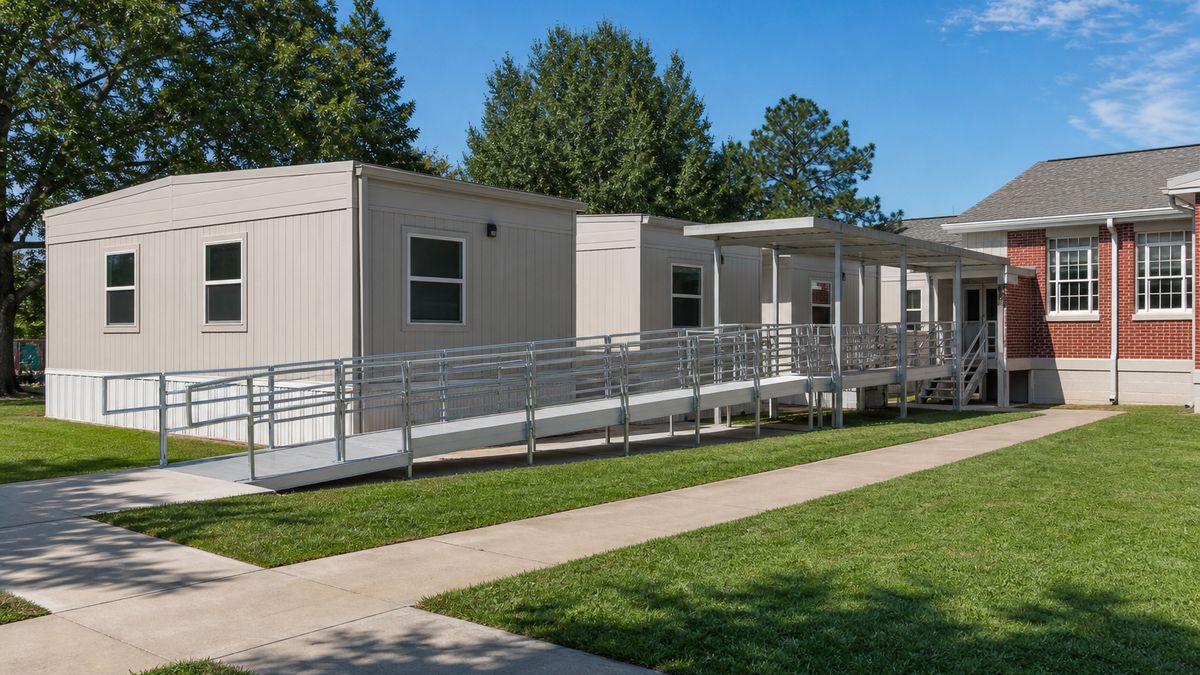
Portable classrooms (also called modular classrooms, relocatable classrooms or school portables) are factory-built classroom buildings that a school district can lease or buy, set on an existing campus and connect to power, data and, if needed, water and sewer. Districts usually lease portables when the need is tied to a few school years of enrollment growth or a construction project, and buy them when the classrooms will be used for many years or need a custom layout. Either way, the schedule is driven as much by approvals, site work and the school calendar as by the building itself.
Quick answer: Lease portable classrooms for short or uncertain needs, such as one to five school years of growth or swing space during a renovation. Buy when you expect to use them long-term, want a custom layout (restrooms, science casework, special education rooms) or plan to place them on a permanent foundation. Start planning early: state plan review, local permits, accessible routes, fire alarm tie-ins and utility work all have to be finished before students move in. Ask suppliers for itemized quotes for both leasing and buying, and compare the total cost over the number of school years you realistically need the space.
Portables are not a niche solution. In a National Center for Education Statistics School Pulse Panel survey released in February 2024, 31% of U.S. public schools reported having one or more portable (non-permanent) buildings in use. This guide covers what those districts weigh when they add classrooms, and what to ask before you sign. If you already know your needs, you can request a free portable classroom quote or see our portable classrooms and modular school buildings page.
Why school districts use portable classrooms
Most districts add portables for one of five reasons:
- Enrollment growth. New subdivisions, boundary changes or a popular program can fill a school faster than a bond-funded building can be designed and built.
- Swing space during construction. When a wing is renovated, rebuilt or abated, portables keep students on their home campus instead of busing them elsewhere.
- Class-size and program changes. Smaller class sizes, expanded pre-K, special education, intervention and tutoring programs all need rooms.
- Emergency replacement. After a fire, flood or storm, temporary classrooms restore instruction while permanent repairs are planned.
- Bridging to a permanent project. Portables cover the gap between today's need and a future building in the long-range facilities plan.
The common thread is time. A permanent school addition can take years to fund, design, approve and build. Modular classrooms are built in a factory while site work and permits proceed in parallel, and lease-fleet or used classrooms already exist, so they can be on campus far sooner. A widely cited McKinsey analysis found modular construction can deliver projects 20% to 50% faster than traditional methods, though savings depend on good design and logistics.
Lease vs. buy: the decision at a glance
| Lease | Buy (new) | Buy (used) | |
|---|---|---|---|
| Typical use | 1–5 school years of growth or swing space | Long-term or permanent classrooms | Long-term use on a tighter budget |
| Up-front cost | Lowest: delivery, setup and site work | Highest: purchase price plus site work | Moderate |
| Annual cost | Lease payments every year | Upkeep, utilities, insurance | Upkeep, utilities, insurance, possible refurbishment |
| Layout | Standard fleet floor plans | Fully customizable | Limited to what's available |
| Budget source | Often operating budget | Often capital or bond funds | Capital or operating, depending on policy |
| End of need | Return, extend or buy out (if offered) | Keep, relocate to another campus or resell | Keep, relocate or resell |
Which budget pays for what is a question for your business office and auditors, but it often decides the answer. A lease can fit an operating budget this year, while a purchase may need board approval and capital funds. See our general rent, lease or buy guide for the same logic applied to offices and job site trailers.
When leasing portable classrooms makes sense
- Enrollment projections are uncertain or expected to level off within a few years.
- The classrooms are swing space for a renovation with a defined end date.
- A permanent addition is funded or planned, and you only need to bridge the gap.
- You want delivery, setup and end-of-term removal handled as one package. Our modular building rental and leasing page explains the options.
Leases are commonly structured around school years, with a minimum term and month-to-month or annual extensions afterward. Ask about early-return terms, buyout options and who restores the site at the end.
When buying portable classrooms makes sense
- The "temporary" need is likely to last many years. Districts across the country have portables that have stayed far longer than planned, and that is exactly when lease payments add up.
- You need rooms a fleet unit can't provide: restrooms inside the building, science sinks and casework, a special education suite, a music room with acoustic treatment, or a multi-classroom building with a corridor.
- You want the building on a permanent foundation to look and perform like the rest of the campus.
- You want the flexibility to move classrooms between campuses as enrollment shifts across the district.
Buying used is a common middle ground: lower cost and faster availability than a new build, as long as the floor plan fits, the unit is in good condition and it can be approved for use in your state.
What drives the cost of portable classrooms
We don't publish prices because they vary widely by region, availability and site. The cost of a portable classroom project depends on these factors, whether you lease or buy:
- Size and configuration. A single classroom, a double, or a multi-classroom building with corridors costs very different amounts. A commonly used single-classroom footprint is about 24 by 40 feet (roughly 960 square feet), but sizes vary by manufacturer and state.
- New vs. used vs. lease fleet. New buildings cost the most and take longest; used and fleet units cost less and move faster.
- Restrooms and plumbing. Adding restrooms means water, sewer and more code requirements, which raises both the building and site cost.
- HVAC and ventilation. Classrooms need equipment sized for a full room of students and your climate, with fresh-air ventilation per code.
- Accessibility. Ramps, landings, handrails, accessible routes from the main building and accessible restrooms where required.
- Foundation or blocking. Temporary blocking with tie-downs is faster and cheaper to remove; permanent foundations cost more but suit long-term use.
- Utilities and low-voltage. Power, data, intercom/PA, clocks, security cameras, access control and fire alarm connections back to the main building.
- Site work. Grading, drainage, walkways, covered walkways, fencing and any paving or landscaping restoration.
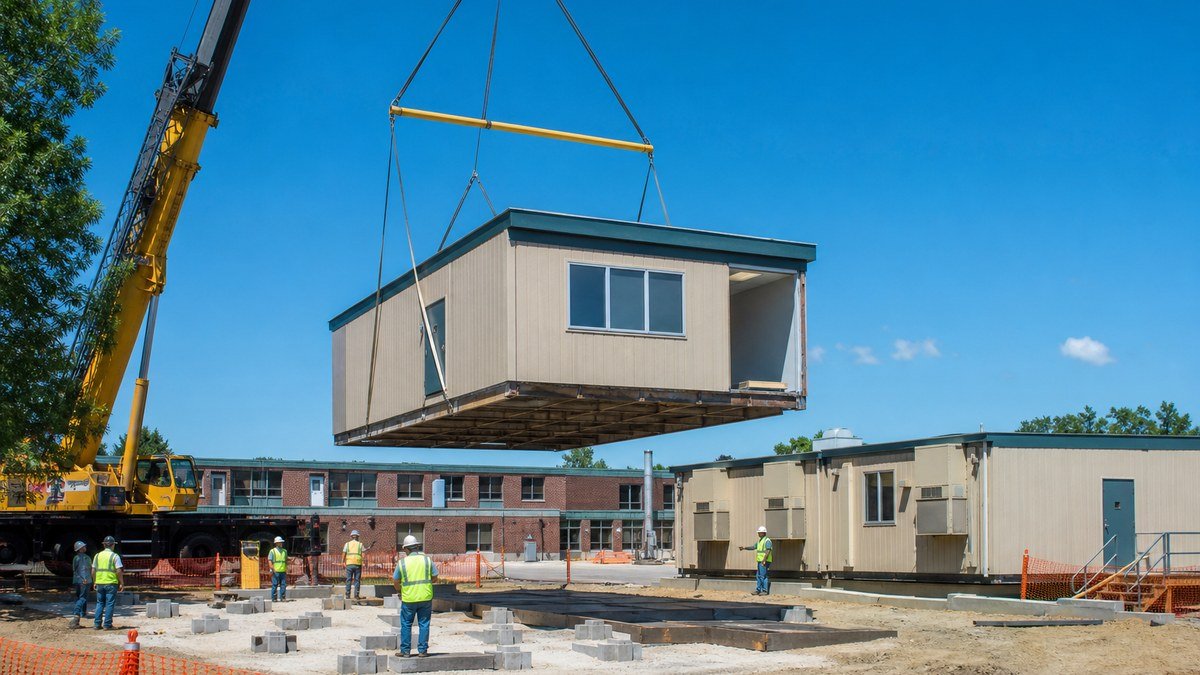
- Delivery and installation. Distance from the factory or fleet yard, site access for trucks and cranes, and the number of modules.
- Approvals and inspections. State plan review fees, local permits and special inspections.
- Removal (leases). Teardown, utility disconnection, return transport and site restoration at the end of the term.
For a fair comparison, ask every supplier for an itemized quote that separates the building, delivery and installation, foundation, ramps and steps, site work, utilities, and removal. Then total each option over the number of school years you need.
Codes and approvals: who signs off on a portable classroom
Classrooms are an educational occupancy, so they carry more requirements than a typical office trailer. The specifics depend on your state, but the approval path usually has three layers:
- The building itself. In many states, modular (industrialized) buildings are built to the state's adopted building code and inspected in the factory under a state program or an approved third-party agency, then labeled. Texas, for example, regulates industrialized buildings through the Texas Department of Licensing and Regulation's Industrialized Housing and Buildings program.
- School-specific review. Some states add a school construction authority. In California, public K–12 school buildings, including relocatable classrooms, fall under the Division of the State Architect (DSA), which reviews plans and oversees construction under the state's school safety rules. Other states route school projects through the state fire marshal, department of education or a school facilities office.
- Local and site permits. The city or county building department, or the state agency with jurisdiction over your schools, typically reviews the foundation or blocking, accessible route, utilities and fire protection.
Your supplier should know which approvals apply to their buildings in your state, and your architect or facilities team should confirm what the site needs. Ask early, because plan review is often the longest single item on the schedule. A used unit approved in one state may not be approvable in another without modifications, so confirm compliance before you commit.
Fire and life safety
Expect requirements for exits and exit hardware, emergency lighting and exit signs, fire extinguishers, and fire alarm devices. Many districts tie portable classrooms into the main building's fire alarm and PA system so students in portables hear the same alerts. Separation distances between portables, and between portables and the main building, are set by the applicable code and fire marshal, so the site plan matters.
Security
Portables sit outside the main building envelope, so security deserves a deliberate plan: lockable doors from the inside, a clear line of sight from the main building, communication with the front office (intercom or phone), cameras and access control that match the rest of campus, and fencing where appropriate. Include these low-voltage systems in the quote rather than adding them later.
ADA and accessibility for portable classrooms
Classrooms must be usable by students, staff and visitors with disabilities. Under the 2010 ADA Standards for Accessible Design, ramps on an accessible route generally:
- Have a running slope no steeper than 1:12 (one inch of rise for every 12 inches of run).
- Rise no more than 30 inches per ramp run before a landing.
- Provide a clear width of at least 36 inches between handrails.
- Have level landings at the top and bottom that are at least 60 inches long, plus handrails and edge protection where required.
Because portables usually sit a few feet above grade on blocking, the ramp can be a significant part of the site layout and cost. Plan the ramp location early so it connects to an accessible route back to the main building, parking and other facilities, not just to the classroom door. Accessible restrooms are required where restrooms are provided. State and local accessibility codes can add requirements beyond the federal standards, so confirm with your architect and building official.
Indoor environment: making portables good places to learn
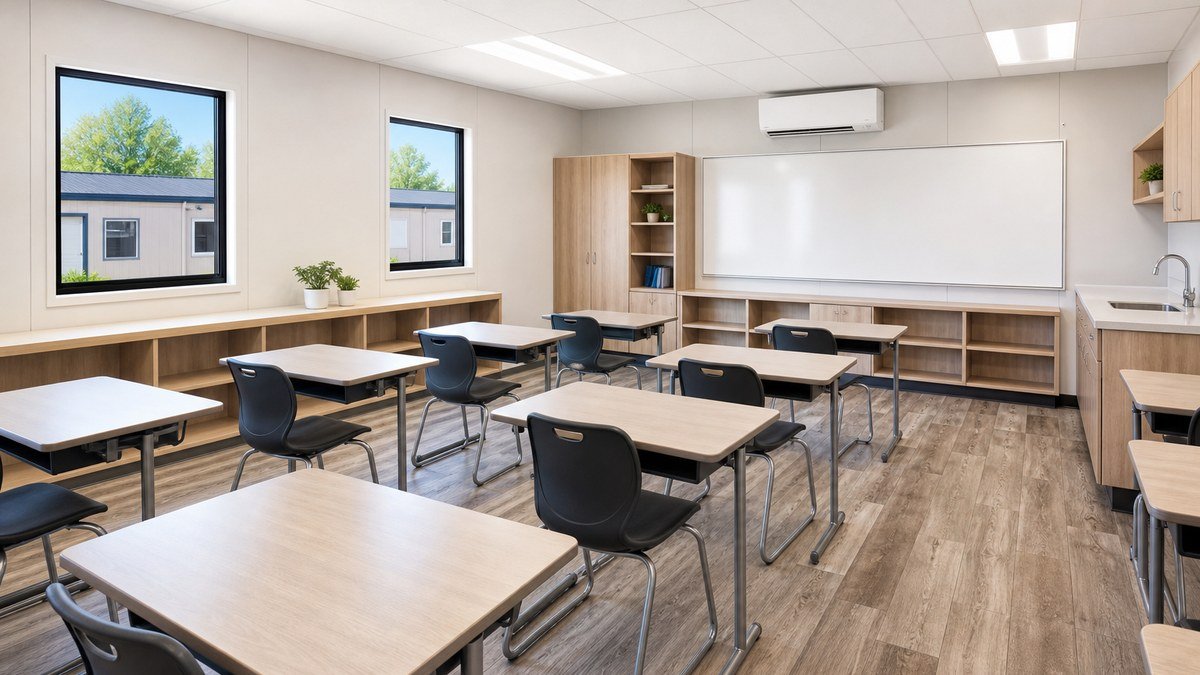
Older portables earned a reputation for being noisy, stuffy or drafty. Current classrooms can be specified to avoid that, but you have to ask:
- Ventilation and HVAC. Make sure the system delivers the required outdoor air and is sized for your climate and a full class. Ask about filtration options and how the thermostat and fan settings are controlled.
- Acoustics. Wall-mounted HVAC units can be loud. Ask about quieter equipment, ceiling and wall finishes, and sound ratings.
- Moisture control. Skirting with ventilation, proper drainage under the building and good roof drainage help prevent moisture and mold.
- Daylight and finishes. Windows, durable flooring and low-emission materials make the room feel like a real classroom.
- Maintenance. Filters, roof, ramps and skirting need routine attention. The U.S. EPA's IAQ Tools for Schools program offers free guidance districts can apply to portables too.
Climate matters as well. In snow country, roofs must be specified for the local design snow load and entries planned for drifting snow; on the Gulf and Atlantic coasts, wind-rated construction and anchorage are essential. Our city pages describe the conditions in each market, for example Denver, Minneapolis and Cleveland for cold and snow, and Dallas, Austin and San Antonio for heat.
Timeline: planning around the school calendar
Most districts want new classrooms ready for the first day of school, which means installation during summer break. Work backward from that date. Every project is different, but the steps are the same:
| Step | What happens | What affects timing |
|---|---|---|
| 1. Define the need | Number of classrooms, program needs, lease vs. buy, budget source | Enrollment projections, board approval cycles |
| 2. Procurement | RFP, bid, cooperative purchasing contract or direct quotes | District purchasing rules and bid thresholds |
| 3. Site plan & design | Placement, accessible route, utilities, fire separation, foundation | Site survey, utility capacity, architect involvement |
| 4. Approvals | State and/or local plan review and permits | Agency workload; completeness of the submittal |
| 5. Production or allocation | New units built in the factory; fleet or used units reserved and refurbished | Factory schedule, fleet availability in your region |
| 6. Site work | Grading, foundation or blocking pads, utility trenches | Weather, contractor availability, school in session |
| 7. Delivery & set | Modules delivered, set, leveled, joined and anchored | Site access, crane needs, number of modules |
| 8. Finish & inspect | Ramps, skirting, utilities, fire alarm, low-voltage, final inspections | Inspection scheduling, punch list |
| 9. Furnish & move in | Furniture, technology, signage, teacher move-in | District IT and custodial schedules |
The practical lesson: many of these steps can't start until the previous one is done, and plan review and procurement often take longer than production. Districts that start in the fall or winter before a summer installation have far more options than those that start in spring. Lease-fleet and used classrooms can shorten step 5, but they do not remove the approval and site-work steps.
Procurement: bids, RFPs and cooperative contracts
Public districts follow state purchasing laws and board policies, which usually require formal bids or proposals above certain dollar thresholds. Common routes include a district RFP or invitation to bid, purchasing through a cooperative contract your state allows, or quotes for smaller purchases. Whatever the route, a clear specification produces comparable prices. Include:
- Number and size of classrooms, and whether you will lease, buy new or buy used (or want pricing for each).
- Required rooms and features: restrooms, sinks, casework, storage, whiteboards, data drops, PA/intercom, fire alarm.
- Lease term, extension options and end-of-term removal and site restoration.
- Foundation type, ramp and steps, skirting, covered walkways.
- Responsibility for site work, utilities, permits and state approvals.
- Required installation window and any work-hour restrictions.
- Warranty terms for purchased buildings and maintenance responsibilities for leased units.
America Modular Buildings can price to district specifications and RFPs through our nationwide network of manufacturers, dealers and installers, and help you compare lease and purchase options side by side.
Single portables, doubles and classroom buildings
Not every project is a single portable behind the gym. Common configurations include:
| Configuration | Typical use | Planning notes |
|---|---|---|
| Single classroom | One extra room for growth or a program | Fastest to place; often lease-fleet or used |
| Double classroom | Two rooms, or one room plus restrooms and storage | Shared ramp and utilities reduce per-room site work |
| Multi-classroom building | A wing of 4–12+ rooms with a corridor | Behaves like a small school building; restrooms and fire protection add scope |
| Two-story modular | More capacity on limited land | Stairs, elevator or accessible alternatives and more structural review |
| Specialty rooms | Science, music, special education, pre-K, offices | Usually new or custom; confirm program requirements early |
Grouping classrooms into one building or a tight cluster usually reduces the cost per room for ramps, utilities and walkways, and makes supervision easier. Districts also use modular buildings for administration and counseling offices and, on larger campuses, for health clinics. During major construction, contractors on the same campus typically use construction trailers for their own field offices.
Three district scenarios
1. A growing suburban elementary school
Two new subdivisions are filling a school past capacity, and the bond for a new school won't be built for several years. The district leases a cluster of classrooms for a multi-year term with extension options, and places them so they can share one ramp and a covered walkway. If the new school is delayed, extending or buying out the lease is cheaper than moving the units.
2. A high school renovation
A two-year renovation of a science wing needs swing space with sinks and casework. Lease fleets rarely have lab classrooms, so the district compares a custom lease with a purchase it can later relocate to another campus as a permanent lab or flex space.
3. A district with shifting enrollment
Enrollment is growing on one side of the district and shrinking on the other. The district buys used classrooms on blocking so it can relocate them between campuses as boundaries change, instead of leasing at each school separately.
Where districts are searching for portable classrooms
We serve school districts, charter and private schools, colleges and early-learning centers in all 50 states. Popular local pages include portable classrooms in Denver, Cleveland, Philadelphia, St. Louis, Chicago, Kansas City, Atlanta and Detroit. Find your area on the locations page.
Checklist: questions to ask before you sign
- Is the quote itemized (building, delivery, installation, foundation, ramps, site work, utilities, removal)?
- Is the classroom new, used or a lease-fleet unit? What is its age and condition?
- Is it approved, or approvable, for educational use in our state? Who prepares and submits the plans?
- What is included for accessibility: ramp, landings, handrails, accessible route, restrooms?
- How will fire alarm, PA, data and security systems connect to the main building?
- What are the HVAC capacity, ventilation rate and noise level?
- What are the lease term, extension, early-return and buyout terms?
- Who is responsible for maintenance, damage and insurance during the lease?
- What warranty applies to a purchased building, and who provides it?
- What is the realistic delivery and installation window for our location, and what could delay it?
Frequently asked questions
How much does a portable classroom cost?
It depends on size, new vs. used vs. lease fleet, restrooms, HVAC, accessibility features, foundation, site work, utilities, delivery distance and whether you lease or buy. Site work and approvals can be a large share of the total. Ask for itemized quotes for both leasing and buying and compare them over the number of school years you need.
Is it better for a school district to lease or buy portable classrooms?
Leasing usually fits short or uncertain needs such as one to five school years of growth or renovation swing space. Buying usually costs less over the long run when classrooms will stay for many years, need a custom layout or will be relocated between campuses.
How long does it take to get a portable classroom?
Lease-fleet and used classrooms can be available sooner than new buildings, which are designed, approved and produced in a factory. In every case, state and local approvals, procurement and site work take time, so most districts plan months ahead of a summer installation.
Do portable classrooms need a permit?
Yes, in almost all cases. Depending on the state, approvals can include factory inspection of the modular building, review by a state school construction authority, and local permits for the foundation, utilities, accessibility and fire protection.
Do portable classrooms have to meet ADA requirements?
Yes. Classrooms must be on an accessible route, and ramps under the 2010 ADA Standards generally have a slope no steeper than 1:12, a maximum rise of 30 inches per run, 36-inch clear width and 60-inch landings. Accessible restrooms are required where restrooms are provided, and state codes may add more.
What size is a typical portable classroom?
A commonly used single-classroom footprint is about 24 by 40 feet, roughly 960 square feet. Doubles and multi-classroom buildings are larger, and exact sizes vary by manufacturer and state requirements.
Can portable classrooms have restrooms?
Yes. Classrooms can include restrooms when water and sewer are available, or districts can add a separate restroom building. Restrooms add plumbing, accessibility and site-work scope.
How common are portable classrooms in U.S. schools?
In a National Center for Education Statistics School Pulse Panel survey released in February 2024, 31 percent of public schools reported having one or more portable buildings in use.
Can portable classrooms be moved to another campus later?
Relocatable classrooms on blocking or temporary foundations are designed to be moved. Relocation requires disconnection, transport, new site work and new approvals at the receiving campus.
How do we get a quote for our district?
Share the number of classrooms, any special rooms, the campus location, your target date and whether you want lease, purchase or both. We return options from our nationwide network of manufacturers, dealers and installers. Call (702) 738-2218 or request a free quote online.
Related
Ready to compare lease and purchase options for your campus? Get a free portable classroom quote or call (702) 738-2218.
Sources
- Institute of Education Sciences / NCES, Nearly one-third of public schools have one or more portable buildings in use (School Pulse Panel, February 2024).
- U.S. Access Board, Guide to the ADA Standards, Chapter 4: Ramps and curb ramps.
- California Department of General Services, Division of the State Architect, Policy PL 07-02: Over-the-counter review of projects (including relocatable buildings).
- Texas Department of Licensing and Regulation, Industrialized Housing and Buildings: FAQ.
- U.S. EPA, Indoor air quality in schools.
- McKinsey & Company, Modular construction: From projects to products (2019).
This guide is general information, not legal, code, financial or procurement advice. Requirements, approvals and availability vary by state, jurisdiction and supplier; confirm them with your architect, building official and purchasing office.