Home › Guides › Temporary buildings for rent
Rental guide
Temporary buildings for rent: types, costs, permits and how to choose (2026)
A practical guide to renting temporary buildings for job sites, schools, offices, clinics, events and emergencies: which type fits, what drives the rental cost, how long you can keep one, and what your site needs before delivery day.
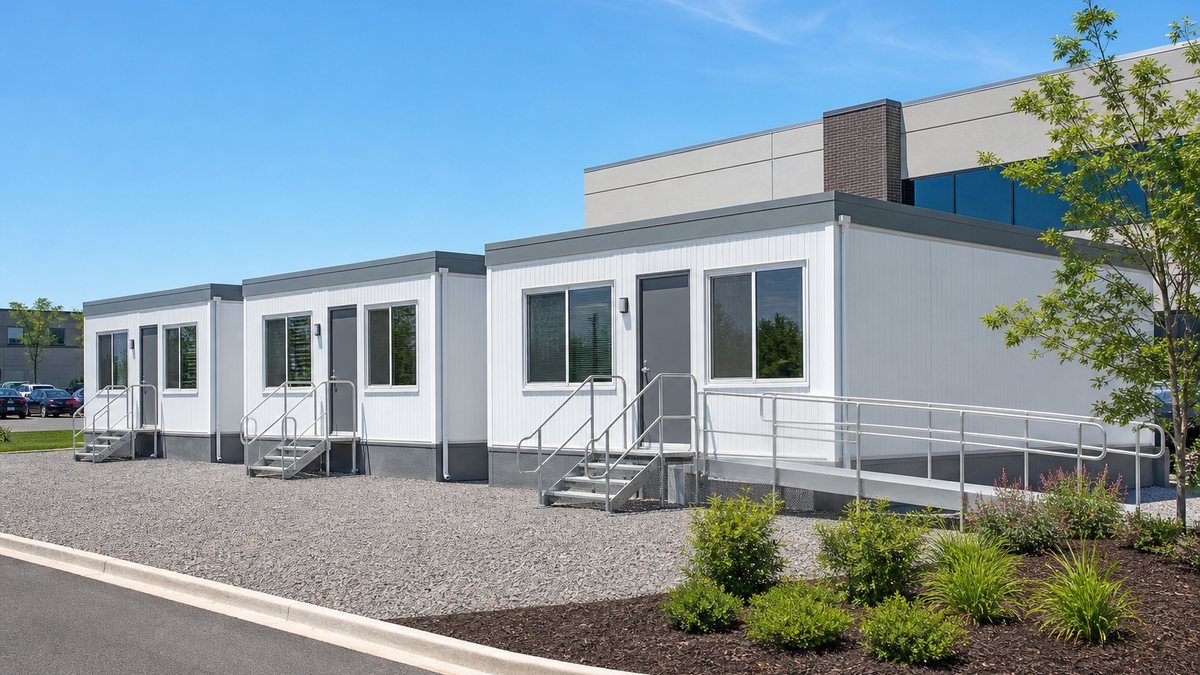
Temporary buildings for rent are factory-built structures, such as mobile office trailers, relocatable modular buildings, portable classrooms, storage buildings and clear-span tents, that are delivered to your site, used for weeks, months or years, then removed at the end of the term. Renting one is the fastest way to add space when the need is short, uncertain or tied to a project, because you pay for the time you use instead of buying or building.
Quick answer: Pick the building type by use (office, classroom, crew space, storage, clinic, event), then the term (short rental vs. multi-year lease). The monthly rate is only part of the cost: delivery, installation, steps and ramps, utility hookups, permits and end-of-term removal often add up to as much as several months of rent. Ask for an itemized quote, confirm what your local building department requires, and plan the site before the unit ships. America Modular Buildings provides temporary buildings for rent in all 50 states through our nationwide network of manufacturers, dealers and installers. Get a free quote.
This guide covers the main types of temporary buildings, typical uses by industry, the factors that drive rental pricing, permits and site preparation, what happens at the end of the term, and a checklist for comparing quotes. If you're weighing renting against leasing or buying in general, our rent, lease or buy decision guide goes deeper on that question, and our modular building rental and leasing page lists the rental options we supply.
What counts as a "temporary building"?
"Temporary" describes how a building is used and permitted, not how flimsy it is. Most rental buildings are relocatable modular buildings: units that are fully or partly built in a factory, designed to be transported, and reused at many sites over their life. The Modular Building Institute describes relocatable buildings as space organizations can "reuse, reconfigure, and move as their needs change," with a useful life on a given site that can range from a few months to several years or longer.
That's different from permanent modular construction, where modules are set on a permanent foundation and become a conventional building. A temporary building usually sits on blocking or a temporary support system with tie-downs, connects to utilities for the term, and leaves when you're done. If you're not sure which approach fits a long-term need, our commercial modular buildings guide compares permanent modular with other construction types.
Types of temporary buildings you can rent
| Type | Typical size (industry ranges) | Common uses |
|---|---|---|
| Mobile office trailer (single-wide) | 8×20 to 12×60 ft | Job site offices, sales offices, guard and gate offices |
| Double-wide modular office | 24×40 to 24×60 ft | Project teams, break rooms, small administrative offices |
| Multi-section modular complex | 1,500 sq ft and up | Temporary admin buildings, swing space, field headquarters |
| Portable classroom | About 24×40 ft per classroom | Enrollment growth, renovation swing space, childcare |
| Modular clinic or exam building | Varies by program | Surge capacity, testing, hospital swing space |
| Storage container or storage building | 20–40 ft containers; custom buildings | Tools, equipment, records and materials on site |
| Restroom or shower building | Varies | Crews, events, camps and facilities under renovation |
| Clear-span tent or temporary structure | From a few hundred to tens of thousands of sq ft | Events, temporary warehousing, disaster response |
Sizes are typical industry configurations; exact dimensions and availability vary by manufacturer, rental fleet and location.
Mobile office trailers
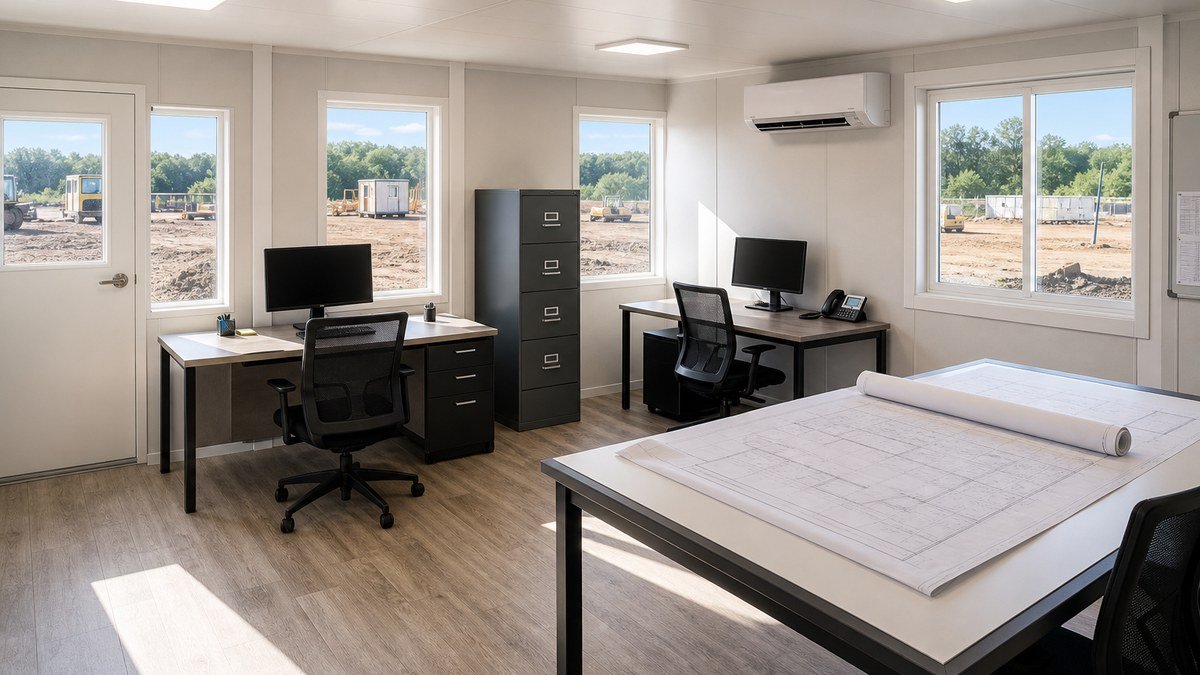
The workhorse of temporary space. Single-wide office trailers arrive with lighting, HVAC and electrical already installed and can be set up quickly on a level, accessible spot. They're the default for contractors, utilities and sales teams. See construction trailers and mobile offices for layouts like superintendent offices and plan rooms.
Relocatable modular offices and complexes
When you need more than a trailer, such as private offices, a conference room, restrooms or a reception area, multiple modules can be joined into a larger temporary building. These are common as swing space during renovations and as temporary headquarters for long projects. Our modular offices page covers configurations from single units to multi-section buildings.
Temporary classrooms
Schools rent or lease portable classrooms for enrollment spikes, construction swing space and programs that outgrow their rooms. Classrooms carry more requirements than offices (occupancy, accessibility, fire alarm and sometimes restrooms), so planning matters. Read our portable classrooms guide for school districts or see portable classrooms and modular school buildings.
Temporary medical buildings
Hospitals and health systems use temporary modular buildings for surge capacity, testing, administrative space and departments displaced by renovation. Clinical use brings stricter design and approval requirements than office use, so the scope is confirmed early. See modular medical buildings and clinics.
Storage and industrial buildings
Secure storage containers and rugged storage buildings keep tools, materials and records on site. Industrial users also rent crew buildings, lunch rooms and workshops near the work. See industrial and storage buildings.
Tents and temporary structures
Clear-span tents cover large areas without center poles and can be fitted with hard walls, doors, flooring, lighting and HVAC. They're used for events, overflow warehousing, sports and disaster response. See commercial tents and temporary structures.
Who rents temporary buildings, and why
| Industry | Typical rental | Why temporary fits |
|---|---|---|
| Construction & general contractors | Office trailers, plan rooms, break rooms, storage | The need ends when the project ends |
| K–12 schools & colleges | Portable classrooms, admin offices | Enrollment shifts and renovation swing space |
| Healthcare | Clinics, testing sites, admin space | Surge capacity and renovations without closing departments |
| Manufacturing & logistics | Yard offices, guard buildings, crew rooms | Peak seasons, plant expansions and shutdowns |
| Energy, utilities & refining | Field offices, turnaround trailers, crew buildings | Remote sites and short, intense outage work |
| Government & emergency management | Offices, shelters, distribution space | Disaster recovery and temporary public services |
| Events & hospitality | Tents, ticket offices, restroom buildings | Space for days or weeks, then gone |
| Retail & real estate | Sales centers, leasing offices | Space tied to a project phase or a store remodel |
What drives the cost of renting a temporary building
Rental pricing varies widely by market, unit and season, which is why we don't publish a price list. What we can tell you is what moves the number, so you can compare quotes on equal terms:
- Building type and size. A single-wide office costs less per month than a multi-section complex or a classroom with restrooms.
- Term length. Longer terms usually lower the monthly rate. Very short rentals carry the highest effective cost because delivery and setup are spread over fewer months.
- Unit age and condition. Newer fleet units and premium finishes typically rent for more.
- Local availability. When units are in the local fleet, delivery is simpler. If a unit has to come from farther away, transport costs rise.
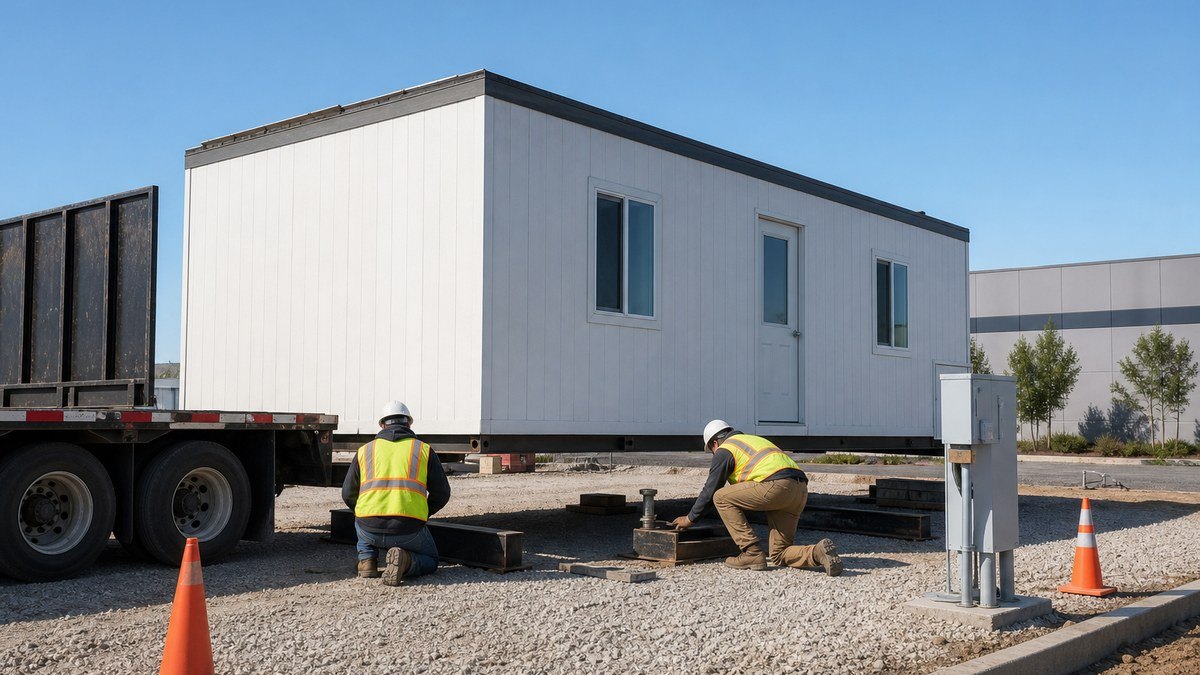
- Delivery and installation. Transport, setting, leveling, blocking and tie-downs are usually one-time charges. Tight urban sites or remote locations can add escorts, cranes or special equipment.
- Site work. Grading, gravel pads, access roads and drainage are often outside the rental quote and handled by a site contractor.
- Utilities. Electrical service, water, sewer or holding tanks and data connections are site-specific and installed by licensed trades.
- Add-ons. Steps with handrails, ADA ramps, skirting, furniture, appliances, security packages and fire extinguishers are often billed monthly or as one-time items.
- Damage waiver and insurance. Many rental agreements require proof of insurance or a damage waiver.
- Removal. Teardown, utility disconnection and return transport at the end of the term may be included or billed separately.
A simple rental cost worksheet
| Cost line | One-time or recurring? | What to ask |
|---|---|---|
| Monthly rent | Recurring | Minimum term? Rate for extensions? |
| Delivery & installation | One-time | Includes blocking, leveling and tie-downs? |
| Steps, ramps, skirting | Either | ADA-compliant ramp included or extra? |
| Furniture & appliances | Usually recurring | What's in the package? |
| Utilities & hookups | One-time (plus usage) | Who provides the electrician and plumber? |
| Permits | One-time | Who pulls them, and what's needed locally? |
| Damage waiver / insurance | Recurring | What's covered, and what's the deductible? |
| Teardown & return | One-time | Included, or billed at the end? |
For a broader look at what drives modular pricing when buying, see our modular office building cost guide.
How long can you rent a temporary building?
There are two different questions hiding here: how long the supplier will rent to you, and how long your building department will let the building stay as "temporary."
Rental terms range from short event and emergency rentals to multi-year leases. Minimum terms vary by supplier, unit and location; many rentals start at a few months. Longer commitments generally lower the monthly rate, and many agreements roll to month-to-month after the initial term.
Code limits are separate. Most states adopt a version of the International Building Code, which treats structures intended to stand for less than 180 days as temporary structures. For example, the City of Ann Arbor's guidance on Michigan's code explains that temporary structures over 120 sq ft need a permit from the building official, with construction documents covering structural strength, fire safety, egress, accessibility, light, ventilation and sanitation. Buildings that stay longer are often reviewed like any other building, and relocatable modular buildings on longer rentals or leases typically go through standard building permits for their site. Local rules vary, so the city or county building department has the final word.
Permits, codes and approvals
Temporary does not mean permit-free. Depending on the building, use and location, you may need:
- A building or placement permit for the unit itself, often with a site plan showing setbacks, access and egress.
- Electrical, plumbing and mechanical permits for utility connections, completed by licensed trades.
- Zoning approval, since some zones restrict temporary structures or limit how long they can stay.
- Fire department review for occupied buildings, larger tents and public-assembly uses.
- Accessibility where the building is open to employees or the public, which usually means a compliant ramp and accessible route.
Commercial modular buildings are generally built to the same building codes as site-built structures, and many states inspect them at the factory under a state program or third-party agency. The Interstate Industrialized Buildings Commission (IIBC) compact helps member states recognize each other's modular approvals, but the building must still meet the codes adopted where it is sited. Your local building department handles site permits, foundations or blocking and utility connections.
Preparing your site
Site surprises are the most common reason a delivery date slips. Before the unit ships, confirm:
- Level, firm ground. A compacted gravel pad or paved area is typical; soft or sloped ground may need grading.
- Truck access. Clear width, overhead clearance and turning room for the delivery truck, and space for a crane if one is needed.
- Utility locations. Power, water, sewer and data close to where the building will sit, with call-before-you-dig locates done.
- Drainage. Water should flow away from the unit, not under it.
- Entry and egress. Room for steps, landings and an ADA ramp where required.
- Security. Lighting, fencing and lockable storage for job sites and remote locations.
Renting vs. other ways to get temporary space
| Option | Best for | Watch out for |
|---|---|---|
| Short-term rental | Projects, events, emergencies, uncertain needs | Highest effective monthly cost on very short terms |
| Multi-year lease | Predictable needs of a year or more | Early-return terms; matching the term to reality |
| Lease-to-own (where available) | Needs that may become permanent | How much of each payment applies to purchase |
| Buying used | Long "temporary" needs on a budget | Age, condition and code compliance for your state |
| Leasing off-site space | Offices where location doesn't matter | Commute, separation from operations, lease length |
Why not just build? Even when the need is long-term, conventional construction takes time to design, permit and build. A widely cited McKinsey analysis found modular construction can deliver projects 20% to 50% faster than traditional methods, with potential savings of up to 20%. For rental buildings that already exist in a fleet, the speed advantage is even clearer: the building is designed and built before you call.
End of term: extend, buy or return
Every rental ends one of three ways. Know the terms for each before you sign:
- Extend. Many agreements convert to month-to-month. Ask for the extension rate in writing.
- Buy. Some suppliers will sell the rented unit; ask whether any rent applies to the price.
- Return. The unit is disconnected, unblocked and hauled away. Ask how much notice is required, what condition it must be in, and who restores the site (gravel, ramps, utility caps).
Temporary buildings for rent near you
Rental availability and permitting are local, so we match each request with partners near the site. We supply temporary buildings for rent in every state, with local pages for 100+ cities, including Los Angeles, Riverside and the Inland Empire, Boston, Newark, Salt Lake City, Sioux Falls, Burlington, Austin, Atlanta and Chicago. Find your city on the locations page, or call (702) 738-2218.
Checklist: questions to ask before you rent
- What size and layout do I need (offices, open area, restroom, storage)?
- What is the minimum term, the monthly rate and the extension rate?
- Is the quote itemized (rent, delivery, installation, add-ons, permits, removal)?
- How old is the unit, and what condition is it in?
- Are steps, an ADA ramp and skirting included?
- Who handles permits, and what does my local building department require?
- What utilities does the unit need, and who connects them?
- What insurance or damage waiver is required?
- What is a realistic delivery date for my location, based on current availability?
- What happens at the end of the term, and who restores the site?
Frequently asked questions
What are temporary buildings used for?
Common uses include construction site offices, portable classrooms, swing space during renovations, temporary clinics and testing sites, storage, crew break rooms, sales and leasing offices, event structures and disaster-recovery space.
How much does it cost to rent a temporary building?
It depends on the building type and size, term length, unit condition, local availability, delivery distance, site work, utilities, add-ons such as steps and ramps, insurance and end-of-term removal. Ask for an itemized quote and compare the total cost over your real term, not just the monthly rate.
What is the minimum rental term for a temporary building?
Minimums vary by supplier, unit and location. Many rentals start at a few months, while events and emergencies can sometimes be shorter. Longer terms usually lower the monthly rate.
Do I need a permit for a temporary building?
Usually, yes. Many jurisdictions require a building or placement permit plus electrical and plumbing permits for hookups. Under codes based on the International Building Code, temporary structures are those intended to stand less than 180 days, and larger ones generally need a permit. Your city or county building department sets the local rules.
How quickly can a temporary building be delivered?
Rental units that are already in a local fleet can often be delivered much faster than a new building, which has to be designed and produced. Timing depends on availability, permits and site readiness, so we confirm a realistic schedule with your quote.
What's the difference between a temporary building and a modular building?
Most temporary buildings are modular: built in a factory and delivered in sections. "Temporary" refers to how the building is used and permitted. Relocatable modular buildings are designed to move and be reused, while permanent modular buildings sit on permanent foundations.
Can I rent a temporary building with a restroom?
Yes. Many modular offices and classrooms can include restrooms, or you can add a separate restroom or shower building. Restrooms need water and sewer connections or holding tanks, which affects site work and permits.
Is it better to rent or buy a temporary building?
Renting is usually best for short or uncertain needs. If you'll use the building for several years, leasing, lease-to-own or buying used may cost less overall. Compare quotes for more than one option over your realistic timeline.
Who handles delivery, setup and removal?
Delivery, installation and end-of-term removal are arranged with the rental through our nationwide network of manufacturers, dealers and installers. Site work and utility connections are often handled by local licensed contractors.
How do I get a quote for a temporary building rental?
Send the building type, approximate size, location, start date and how long you need it. We'll return options from our network so you can compare. Call (702) 738-2218 or use the quote form on our contact page.
Need temporary space?
Tell us the building type, size, location and dates. Free, no-obligation quote.
Related
Sources
- Modular Building Institute, Relocatable / portable buildings (definition and uses of relocatable modular buildings).
- City of Ann Arbor, Temporary structures info sheet (Michigan Building Code Section 3103: 180-day limit, permits for structures over 120 sq ft).
- McKinsey & Company, Modular construction: From projects to products (2019).
- Interstate Industrialized Buildings Commission, FAQ (interstate compact for modular approvals).
This guide is general information, not legal, engineering or financial advice. Rental terms, availability, permits and requirements vary by supplier and location.