Home › Guides › Mobile buildings
Buying guide
Mobile buildings and mobile offices: types, mobile vs. modular, and how to rent or buy (2026 guide)
What people mean by "mobile buildings", how mobile office trailers differ from modular buildings and manufactured homes, which type fits offices, classrooms, job sites and command posts, and what to settle before you rent, lease or buy.
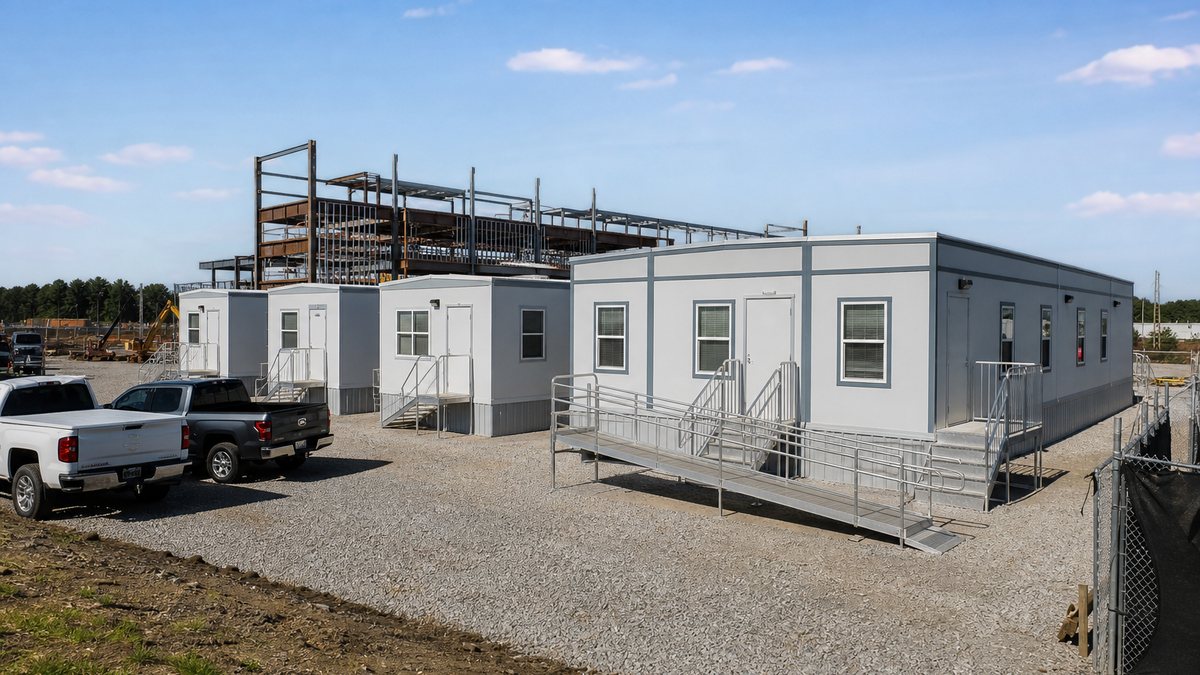
Mobile buildings are factory-built structures, such as mobile office trailers, portable classrooms, restroom units and relocatable modular buildings, that are delivered to a site ready or nearly ready to use and can be moved again later. In commercial use, the term usually covers two families: mobile office trailers, built on a steel chassis that stays with the unit, and relocatable modular buildings, built in sections that are set on blocking or a foundation. Both are different from HUD-code manufactured homes, which are built as dwellings under a separate federal standard.
Quick answer: If you need a standard office or break room on a job site or yard for months to a few years, a mobile office trailer is usually the fastest and simplest choice, and most are rented. If you need more space, a custom layout, restrooms, classrooms or a building that may stay for years, a relocatable or permanent modular building is usually the better fit. Either way, the total cost depends on size, term, delivery distance, site work, utilities, steps and ramps, and removal, so compare itemized quotes rather than monthly rates. A "mobile home" (HUD-code manufactured home) is a dwelling and is generally not the right product for an office, classroom or other commercial use.
This guide explains the vocabulary, compares the building types side by side, and walks through uses, codes and permits, delivery and setup, renting versus buying, cost factors and local considerations. It is written for contractors, facility managers, school districts, public agencies and businesses comparing options. To see what we supply through our nationwide network of manufacturers, dealers and installers, visit construction trailers and mobile offices or request a free quote.
What "mobile buildings" means (and why the words get confusing)
Buyers, suppliers and building officials use overlapping words for buildings that are made in a factory and moved by truck. The labels matter because they often decide which code applies, who inspects the building and whether a city will permit it where you want it. Here is how the common terms are normally used:
- Mobile building: an informal, catch-all term for any transportable commercial building. Search engines and buyers use it for everything from a single office trailer to a multi-section classroom building.
- Mobile office or office trailer: a single-wide (or occasionally double-wide) unit built on a steel chassis with axles and a hitch, typically used as a job site or field office. Industry guides describe standard footprints from roughly 20 to 60 feet long.
- Portable or relocatable building: a modular building designed to be transported and reused at more than one site. The Modular Building Institute describes relocatable buildings as staying on a site for anywhere from a few months to several years or longer.
- Modular building: a building constructed in sections (modules) in a factory, transported to the site and joined there. It can be relocatable or permanent.
- Manufactured home (often still called a mobile home): a dwelling built on a permanent chassis under the federal HUD code. It is a housing product, not a commercial building type.
When you request quotes, describe the use (for example "office for eight people on a highway project for 18 months") rather than only the label. That gets you the right product and avoids comparing a trailer quote with a modular building quote as if they were the same thing.
Mobile office trailers vs. modular buildings vs. manufactured homes
| Mobile office trailer | Relocatable / permanent modular building | Manufactured home (HUD code) | |
|---|---|---|---|
| Built for | Temporary offices, job sites, field operations | Offices, classrooms, clinics, restrooms, break rooms, permanent facilities | Housing (a dwelling) |
| Chassis | Built on a steel chassis that usually stays with the unit | Built with or without a chassis; sections are set on blocking or a foundation | Built on a permanent chassis |
| Code basis | Varies by state; many are built and labeled under the state's commercial modular or industrialized building program | State-adopted building codes for the site where it is installed, usually with factory inspection and a state label | Federal HUD Manufactured Home Construction and Safety Standards |
| Size range | Standard single-wide and double-wide footprints | From one module to large multi-story buildings | Residential sizes |
| Customization | Limited to standard floor plans and add-ons | Wide: layout, finishes, restrooms, HVAC, specialized rooms | Residential options |
| Typical term | Weeks to a few years, usually rented | Months to permanent; rented, leased or bought | Long-term residential |
| Setup | Towed or hauled in, then leveled, blocked and anchored | Hauled in sections, craned or rolled into place, joined and connected | Installed under state manufactured housing rules |
State agencies draw the same line. Maryland, for example, explains that a manufactured home is "built on a permanent chassis and designed to be used as a dwelling" under federal HUD standards and carries a red HUD label on each section, while an industrialized (modular) building is "built with or without a chassis," follows state standards and carries a state label, and the state's definition of an industrialized building excludes manufactured homes. Georgia's Department of Community Affairs has likewise reminded local governments that industrialized buildings bearing the state insignia are regulated like site-built construction, while manufactured homes are built to federal HUD standards.
Common types of mobile buildings and what they are used for
| Type | Typical uses | Usually |
|---|---|---|
| Single-wide office trailer | Superintendent office, plan room, small field office | Rented for the length of the project |
| Double-wide or multi-section office | Project teams, owner and engineer offices, conference space, break rooms | Rented or leased |
| Ground-level office (no chassis) | Yard, gate or dispatch offices where step-free access is wanted | Rented or bought |
| Mobile or portable classroom | Enrollment growth, swing space during renovations | Leased for school years or bought |
| Restroom and shower buildings | Job sites, events, camps, schools, industrial shutdowns | Rented or leased |
| Mobile command and incident centers | Emergency response, utilities, public safety, large events | Rented for the event or bought by agencies |
| Container-based offices | Secure storage with an office end, tight or remote sites | Rented or bought |
| Mobile medical and clinic buildings | Testing, screening, temporary clinic capacity | Leased or bought |
| Storage buildings | Tools, materials, records, seasonal stock | Rented or bought |
Each type has its own page or guide on our site. For job site offices see construction office trailer sizes; for classrooms see portable classrooms; for clinics see healthcare and medical facilities; for storage see industrial and storage buildings; and for offices that will stay longer see modular offices and commercial spaces.
How to choose: mobile office trailer or modular building?
Most decisions come down to five questions. Answer them before you call suppliers and you will get comparable quotes much faster.
- How long will you need it? For a few weeks to a couple of years, a fleet trailer or relocatable unit is usually the simplest answer. For many years, compare a purchased relocatable building with a permanent modular building.
- How many people, and doing what? A two-person field office is a single-wide. A project team with a conference room, restrooms and a break room points to a double-wide or multi-section building. Classrooms, clinics and public-facing offices bring more code requirements.
- Do you need restrooms or running water? Plumbing changes the site work, permits and sometimes the building type. Many short-term job sites pair a dry office with separate restroom units instead.
- Who will use it, and how will they get in? Staff-only job site offices, public offices and classrooms have very different access needs. Steps, ramps, landings and ground-level units all change the layout of your site.
- Will it move again? If the building is likely to move to another site or another part of the campus, choose a relocatable unit and keep the documentation (state label, data plate and plans) with it.
As a rule of thumb, the simpler and shorter the need, the more a mobile office trailer makes sense. The more people, plumbing, customization and years involved, the more a modular building makes sense. Our commercial modular buildings guide goes deeper into permanent options.
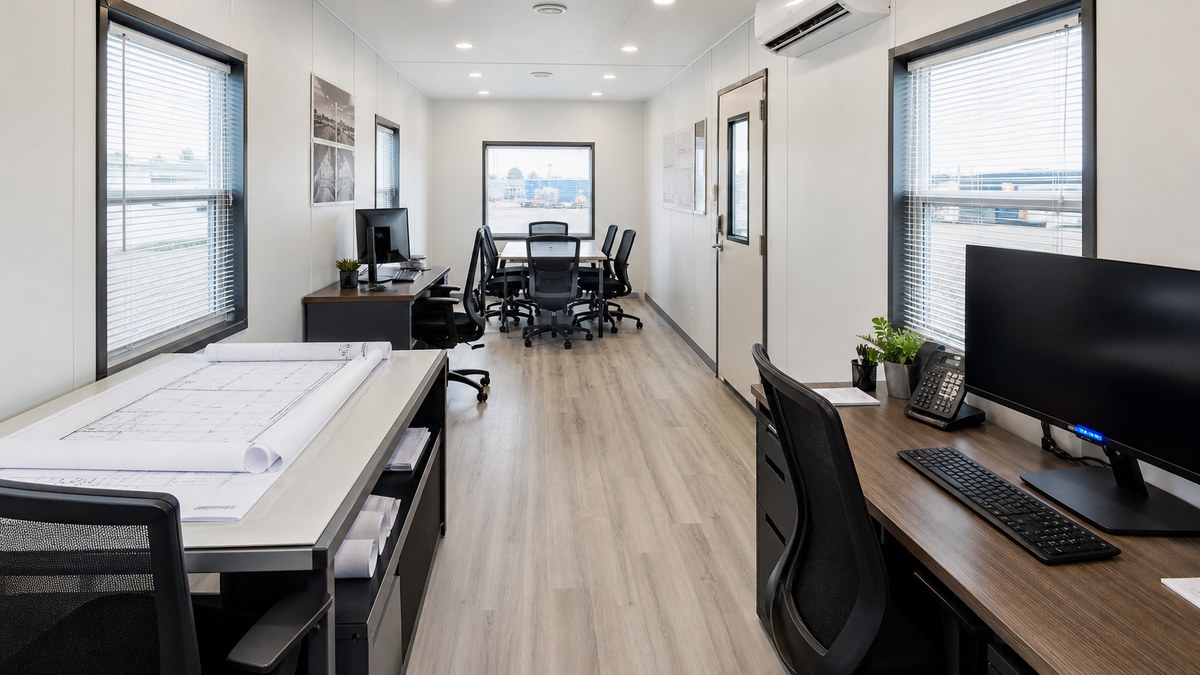
Codes, labels and permits for mobile buildings
Commercial modular buildings are generally built to the same building codes as site-built structures. In many states they are reviewed and inspected in the factory under a state program or a third-party agency, and each section receives a state label or insignia. The Interstate Industrialized Buildings Commission coordinates approvals among its member states, but wherever a building is built, it must meet the codes adopted where it is sited. The local building department still handles the site permit, foundation or blocking, and utility connections.
Points that come up most often with mobile buildings:
- State labels and data plates. Check that each section carries the label or insignia required by the state where it will be installed, and that the data plate lists design loads and occupancy. Texas, for example, requires the builder to disclose the data plate information and the location of the decals or insignia on the modules.
- Relocated buildings. The International Building Code has a section on relocatable modular buildings, and existing relocatable buildings are directed to the International Existing Building Code. Some states require relabeling or a new inspection when a used building moves in from another state, and design loads such as wind and snow must suit the new site.
- Temporary vs. permanent. Many jurisdictions treat a building differently depending on how long it stays. Under the Michigan Building Code, as summarized by the City of Ann Arbor, temporary structures are those in place for less than 180 days, and a permit is required over 120 square feet. Rules elsewhere vary, so ask the city or county building department early.
- Zoning. Zoning codes decide where a building may go, setbacks, parking and how long a temporary structure may stay. Construction-site offices are often allowed for the duration of an active building permit.
- Electrical and plumbing. Expect separate permits for the power drop, water, sewer or holding tanks, done by licensed trades.
Delivery and setup: what happens on install day
The building is only as good as the site it sits on. Whether the unit is towed in on its own chassis or delivered in sections and set by crane, the steps are similar:
- Site survey. Confirm the location, access route, gate widths, overhead lines, turning room for the truck and, where needed, crane setup space.
- Pad preparation. Level, compacted, well-drained ground. A gravel pad is common for temporary units; permanent buildings may need a perimeter foundation or slab.
- Utility locates. Call before you dig so underground lines are marked before stakes, anchors or trenches go in.
- Delivery. Mobile office trailers are positioned with a truck or yard tractor; multi-section buildings may need a crane or rolling system.
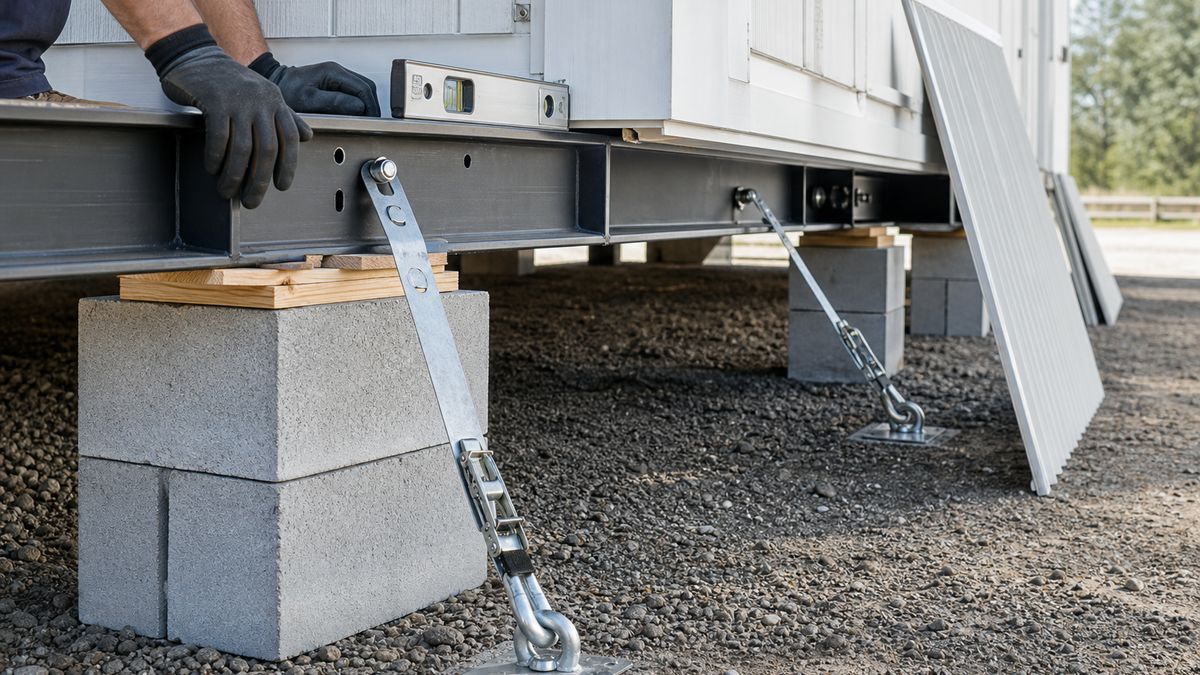
- Leveling and blocking. Units are set on blocking or supports at the spacing the manufacturer specifies.
- Anchoring and tie-downs. Anchors are installed to resist wind and uplift according to the manufacturer's instructions and local requirements. In hurricane-prone or high-wind areas this step deserves extra attention.
- Joining sections. Multi-section buildings are joined at the marriage line, sealed and finished inside.
- Utilities and inspection. Electrical, water, sewer and data are connected and inspected, followed by any final building inspection.
- Steps, ramps and skirting. Access is installed last, along with skirting to close off the underside.
At the end of a rental or lease the process reverses: disconnect, remove access and skirting, release anchors, pick up the unit and restore the site. Ask who pays for each of those steps before you sign.
Need a mobile office or modular building?
Tell us the site, use, size and timeline. Free, no-obligation quote.
Rent, lease or buy a mobile building?
Mobile buildings are among the most rented building types in the country, because many needs have an end date. The general rule is the same as for any modular building, explained in detail in our rent, lease or buy guide:
| Situation | Usual choice | Why |
|---|---|---|
| Construction project with a fixed end date | Rent | Fleet trailers arrive ready and leave when the job ends |
| Event, emergency or incident response | Rent | Short, urgent need; standard units are usually fastest |
| Classroom growth for several school years | Lease | Lower monthly cost than short rentals, with extension options |
| Swing space during a renovation | Lease for the project length | Space for displaced staff until the permanent building reopens |
| Yard, gate or dispatch office that will stay | Buy (new or used) | Lowest long-term cost, full control over layout |
| Agency that deploys a command post several times a year | Buy | Ready when needed without rental lead time |
Some suppliers offer lease-to-own programs, and used and ex-rental units can be a budget-friendly way to buy. Our modular buildings for sale guide includes a used-building inspection checklist, and the modular building rental and leasing page and temporary buildings for rent guide cover short-term options.
What drives the cost of a mobile building
We don't publish prices, because the honest answer depends on your site, term and spec. These are the factors that move mobile building quotes the most:
- Size and configuration. Single-wide, double-wide or multi-section; number of private offices, restrooms and open areas.
- Rental term. Monthly rates generally fall as terms get longer.
- New, used or fleet unit. Fleet and used units cost less and are often available sooner; new units can be customized.
- Delivery distance and logistics. Transport, escorts, oversize permits, cranes and difficult access add cost.
- Site work. Grading, gravel or concrete pads, drainage, foundations and paved access.
- Anchoring and design loads. Wind, snow and seismic requirements at your site affect tie-downs and sometimes the unit itself.
- Utilities. Power service, water, sewer or holding tanks, data and their permits.
- Access. Steps, landings, ramps and handrails, especially where accessibility is required.
- Add-ons. Furniture, skirting, security packages, window bars, appliances, damage waivers and IT.
- Removal. Teardown, return transport and site restoration at the end of the term.
Why mobile and modular buildings save time
The main reason organizations choose mobile and modular buildings is speed. A rental unit that already exists can be in use long before a site-built structure could be designed and permitted. For new modular buildings, the building is produced in a factory while the site is prepared and permits are processed. A widely cited McKinsey analysis found modular construction can accelerate projects by 20% to 50%, with potential cost savings of up to 20%, while noting that savings depend on good design and logistics. A summary of a U.S. Department of Energy-funded field study published by the National Institute of Building Sciences reported modular projects about 30% faster with roughly 5% lower cost, with 40% to 60% of the work done off site.
Relocatable buildings add a second benefit: when the need ends, the building can be moved to the next site or returned instead of demolished. The Modular Building Institute's 2023 annual report estimated that permanent modular construction accounted for about 6% of new construction starts in 2022, up from about 2% in 2015 in a North American industry worth more than $12 billion.
Local considerations: climate, codes and access
The same building can need different specs in different cities. A few patterns we see often:
- Cold and snowy regions such as Minneapolis, Bismarck, Detroit and Cleveland: confirm the roof snow load rating, insulation, heating capacity, skirting and frost-safe water and sewer connections. Plan snow removal around steps and ramps.
- High-altitude and dry climates such as Denver: large temperature swings and strong sun make insulation, window shading and HVAC sizing important; check local snow and wind loads too.
- Big-city sites such as Chicago and Philadelphia: tight streets, overhead lines and limited delivery windows can make access and crane planning the biggest variable.
- Hot, humid and storm-prone areas such as New Orleans, Orlando and Houston: wind-rated anchoring, drainage, flood considerations, cooling capacity and moisture control matter most.
- Fast-growing Sun Belt metros such as Dallas, Atlanta, Charlotte, Nashville and Tulsa: busy construction markets keep demand for job site offices high, so start the conversation early and confirm availability for your dates.
- Port and logistics cities such as Long Beach and Kansas City: container offices and yard offices are common, and secure, durable units are often preferred.
Each city page covers local details such as the county, nearby towns and climate. Find yours on the locations page.
Four mobile building scenarios
1. A general contractor starting a 20-month project
The team needs a superintendent office, a plan room and a meeting space, plus restrooms for the crew. A rented double-wide mobile office with separate restroom units covers it, delivered once the pad and power are ready and removed at closeout. Because the office is directly associated with construction, ADA accessibility requirements generally don't apply, though many contractors still add a ramp for owner and inspector visits.
2. A school district that needs two classrooms by August
Enrollment rose faster than planned. Leased relocatable classrooms, set on blocking with ramps and connected to the campus fire alarm, provide space for the next few school years. If the need becomes permanent, the district can compare buying the units with a permanent classroom wing. See our modular school buildings guide.
3. A distribution yard that wants a permanent gate office
Drivers check in around the clock and the old shed is worn out. A purchased ground-level modular office with a driver window, restroom and HVAC, on a permanent foundation, gives a long-term solution at the lowest lifetime cost.
4. A utility that needs an incident command post during storms
The need is unpredictable but recurring. Some agencies rent a mobile command building for each event; others buy a unit so it is ready when needed. The decision depends on how often the unit is used and how quickly a rental can arrive in that region.
Checklist: questions to ask before you rent or buy
- What exactly will happen in the building, how many people will use it, and for how long?
- Is the unit a chassis-mounted office trailer or a modular building, and does it carry the label my state requires?
- Is it new, used or a fleet unit, and how old is it?
- What wind, snow and seismic loads is it rated for at my site?
- Is the quote itemized (building, delivery, installation, anchoring, site work, utilities, access, add-ons, removal)?
- Who handles permits, utility connections and inspections?
- Are steps, ramps and landings included, and do accessibility requirements apply to my use?
- What are the minimum term, extension and early-return terms?
- Who is responsible for damage, maintenance and insurance during the term?
- What happens at the end: extend, buy, or return and restore the site?
- What is a realistic delivery date for my location, based on current availability, approvals and site readiness?
Frequently asked questions
What is a mobile building?
A mobile building is a factory-built commercial structure, such as a mobile office trailer, portable classroom, restroom unit or relocatable modular building, that is delivered to a site and can be moved again later. The term is informal and covers both chassis-mounted trailers and modular buildings set on blocking or foundations.
What is the difference between a mobile building and a modular building?
A mobile office trailer is typically a single-wide or double-wide unit built on a steel chassis that stays with it, used mostly for temporary offices. A modular building is built in sections, set on blocking or a foundation and joined on site, so it can be larger, more customized and either relocatable or permanent.
Is a mobile office the same as a mobile home?
No. A mobile home, now called a manufactured home, is a dwelling built on a permanent chassis under the federal HUD code. Mobile offices and commercial modular buildings are non-residential buildings, usually built and labeled under state building programs and local building codes.
Can I rent a mobile building?
Yes. Mobile office trailers, relocatable offices, portable classrooms and restroom units are commonly rented or leased for construction projects, events, emergencies, renovations and enrollment growth. Longer terms usually lower the monthly rate.
Do mobile buildings need a permit?
Usually, yes. Many jurisdictions require placement, building, electrical or plumbing permits even for temporary units, and zoning rules may limit how long a temporary building can stay. Check with the city or county building department before delivery.
Do mobile office trailers have to be ADA accessible?
Under the 2010 ADA Standards, construction trailers directly associated with a construction project are exempt from accessibility and accessible route requirements. Offices, classrooms and other mobile buildings used by the public or by employees generally need accessible entrances, routes and, where provided, restrooms.
How are mobile buildings anchored?
Units are leveled on blocking or supports and secured with anchors and tie-down straps installed according to the manufacturer's instructions and local wind requirements. Permanent modular buildings are attached to permanent foundations instead.
How much does a mobile building cost?
It depends on size and configuration, rental term, new versus used, delivery distance, site work, anchoring, utilities, steps and ramps, add-ons and removal. Compare itemized quotes for your site rather than relying on average prices.
Can a mobile building be moved to a new site?
Yes, that is what relocatable buildings are designed for. A move usually means new site work, utility connections and local approval at the new location, and some states require relabeling or inspection when a used building comes from another state.
How do I get a quote for a mobile building?
Share the site address, how the building will be used, how many people it needs to hold, the timeline and whether you want to rent, lease or buy. We return options from our nationwide network of manufacturers, dealers and installers. Call (702) 738-2218 or request a free quote online.
Related
Sources
- Maryland Department of Labor, Manufactured (mobile) homes and modular buildings (HUD-code vs. industrialized building definitions and labels).
- Georgia Municipal Association, DCA clarifies rules for modular buildings vs. manufactured homes.
- U.S. Department of Housing and Urban Development, Manufactured Housing: Reflections From HUD Leadership (2016).
- Texas Department of Licensing and Regulation, Before purchasing an industrialized home or building.
- Interstate Industrialized Buildings Commission, FAQ.
- Modular Building Institute, Relocatable / portable buildings; IBC relocatable buildings section; 2023 Permanent Modular Construction annual report.
- Triumph Modular, The differences between mobile offices and modular buildings (trailer footprints).
- U.S. Department of Justice, 2010 ADA Standards for Accessible Design, §203.2 and §213 (construction sites).
- McKinsey & Company, Modular construction: From projects to products (2019).
- National Institute of Building Sciences, 2024 summary of a U.S. Department of Energy-funded field study on modular construction.
- City of Ann Arbor, temporary structures information sheet (Michigan Building Code §3103).
This guide is general information, not legal, engineering, code or financial advice. Building types, availability, codes, permits and requirements vary by supplier, state and location; confirm requirements with the local building department, zoning office and your design professional.