Home › Guides › Portable office buildings
Portable offices
Portable office buildings: types, sizes, rent vs. buy and how to choose (2026 guide)
What a portable office building is, how it differs from a mobile office trailer, a container office and a modular office, which sizes fit 1 to 50 people, what permits and site work to expect, and how to compare rental and purchase quotes near you.
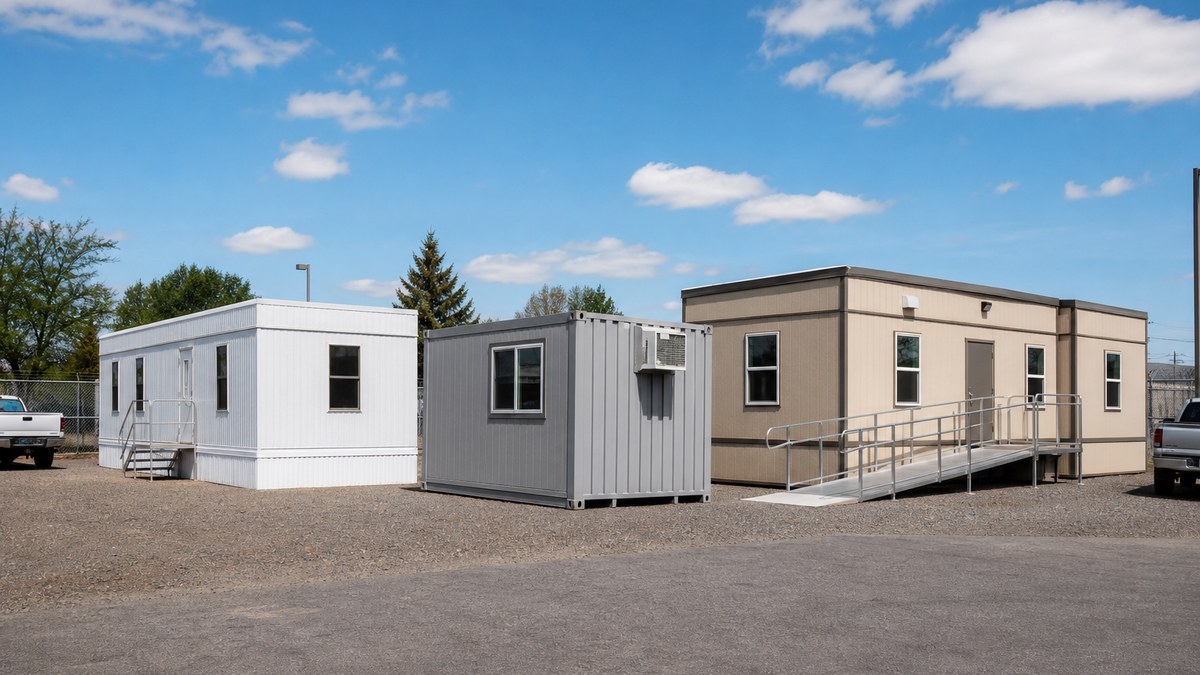
Portable office buildings are factory-built offices that are delivered to your site in one or more pieces, set on blocking or a simple foundation, connected to power (and sometimes water and sewer) and used right away. Later they can be picked up and moved to the next site. The term covers mobile office trailers, skid-mounted portable offices, shipping-container offices, small prefab guard and ticket booths, and relocatable modular offices. They are rented, leased or bought by contractors, schools, plants, hospitals, events, retailers and government agencies that need office space quickly without building a permanent structure.
Quick answer: For 1 to 4 people, a single portable office (a small trailer, skid office or container office) is usually enough. For 5 to 15 people, look at larger single-wide or double-wide mobile offices. Past roughly 15 to 20 people, or for long stays, a multi-section relocatable modular office is usually the better fit. Most portable offices are wider than the 8 foot 6 inch legal road width, so delivery needs oversize permits, and the building still needs a level pad, anchoring, power, steps and often an ADA ramp. Your city or county building department decides which permits apply. Prices depend on size, term, finishes, delivery distance and site work, so compare itemized quotes rather than monthly rates alone.
This guide is for project managers, facility managers, school and plant administrators, event organizers and business owners shopping for portable office space. We supply portable office buildings for rent, lease and sale through our nationwide network of manufacturers, dealers and installers. See construction trailers and mobile offices, modular offices and commercial spaces and modular building rental, or request a free quote with your headcount, site address and dates.
What is a portable office building?
"Portable office" is a buyer's term, not a code category. People use it for any office building that is built somewhere else, delivered whole or in a few sections, and designed to be moved again. Building departments and manufacturers use more specific names, and those names matter because they decide which rules apply. The Modular Building Institute describes relocatable buildings as buildings designed to be transported and reused, with time on a site that can range from a few months to several years or longer.
Three ideas separate a portable office from other office space:
- Built off site. Walls, floor, roof, wiring, lighting, HVAC and finishes are completed in a factory or shop.
- Delivered ready to use. Setup takes hours or days for small units, not months of construction.
- Movable. The building is designed to be disconnected, loaded and reused at another site.
If you're also comparing words like "mobile building", "manufactured" and "modular", our mobile buildings guide explains how trailers, modular buildings and HUD-code manufactured homes are regulated differently.
Types of portable office buildings
| Type | How it's built and moved | Typical uses | Watch for |
|---|---|---|---|
| Mobile office trailer | Office on a steel chassis with axles and a hitch; towed in and set on blocking | Construction sites, sales offices, temporary branch offices | Steps, skirting, tie-downs, oversize delivery |
| Double-wide or multi-section mobile office | Two or more chassis units joined side by side into one building | Larger project offices, swing space, school and plant offices | Mate-line sealing, more site work, more permits |
| Container office | Steel ISO shipping container or container-style unit fitted out as an office; moved by truck and forklift or crane | Yards, ports, remote and high-security sites, pop-ups | Insulation, condensation, code review for repurposed containers |
| Skid-mounted portable office | Small office on steel skids, set by forklift or crane | Plant yards, oil and gas, gate offices, tool rooms | Size limited by lifting equipment and site access |
| Prefab booth | Small steel or panel building, often one room, delivered whole | Guard and security booths, parking and ticket booths, scale houses | Wind anchoring, power and data to a small footprint |
| Relocatable modular office | Code-built modules joined on site, set on blocking or a foundation, designed to move again | Multi-year offices, admin buildings, campus swing space | State modular approvals, more site work, crane or skid delivery |
Portable offices can also go inside a building. Panelized in-plant offices are assembled on a warehouse or factory floor and can be taken apart and moved later; see our in-plant offices guide and in-plant offices. Booths and unusual one-off buildings fall under custom and specialty structures.
Portable office vs. mobile office trailer vs. modular office
Buyers often search for all three at once. The practical differences:
| Question | Portable office (small unit, container or booth) | Mobile office trailer | Modular office building |
|---|---|---|---|
| Size | Smallest; often one room | Fixed footprints; Triumph Modular describes common trailers as roughly 20 to 60 feet long | Scales from one module to large multi-story buildings |
| Setup | Set by truck, forklift or crane; minimal site work | Towed in, blocked, leveled and anchored | Modules set and joined; mate lines finished on site |
| Best term | Days to years | Months to a few years | Several years to permanent |
| Restrooms | Usually none; portable toilets or nearby building | Optional, if water and sewer are available | Common; plumbing code fixture counts apply |
| Code path | Varies: building permit, temporary structure rules or container review | Local permits; temporary use and anchoring rules | State modular program and local permits, like site-built |
As a rule of thumb, the longer you need the space and the more people use it, the more it pays to move up from a small portable unit to a trailer, and from a trailer to a modular office. Our modular office buildings guide covers module sizes and floor plans for larger offices.
Portable office building sizes
Portable office sizes are set by what a truck can legally and practically carry. The standard legal width on U.S. roads is 8 feet 6 inches; units wider than that travel as oversize loads with state permits, and some widths need escort vehicles. That's why you'll see portable offices in a few clusters:
- Container widths. Standard ISO shipping containers are 8 feet wide and nominally 20 or 40 feet long, which is why container offices fit on a normal road load. The narrow width makes them good single offices and tool rooms but tight for groups.
- Narrow trailers. Trailers at or near legal width are easy to move and common for small job-site offices.
- Wide trailers and modules. Wider units give more usable room inside. A modular buyer's guide from 360connect notes common module widths of 12 feet, 13 feet and 13 feet 9 inches, with some builders offering wider modules, and most modules built up to 60 feet long.
- Multi-section buildings. When one unit isn't enough, two or more sections are joined into a double-wide or larger office, and each section travels as its own load.
Exact sizes differ by supplier and fleet, so always ask for both the exterior dimensions and the usable interior square footage. Our construction office trailer sizes guide lists common trailer footprints and layouts in detail.
How many people fit in a portable office?
| Team size | Usually fits | Typical layout |
|---|---|---|
| 1 to 2 people | Small container office, skid office or booth | One room, desk, plan shelf, HVAC unit |
| 3 to 6 people | Single-wide mobile office | Open area plus one private office, optional restroom |
| 6 to 15 people | Larger single-wide or double-wide | Private offices at the ends, open area or plan table in the middle, restroom |
| 15 to 50+ people | Multi-section relocatable modular office | Private offices, conference room, break room, restrooms |
These are planning ranges, not code limits. For code purposes the International Building Code generally counts office areas at 150 gross square feet per occupant and conference rooms with tables and chairs at 15 net square feet per person; those numbers drive exits and restroom counts. Your design professional or supplier confirms the numbers for your plan.
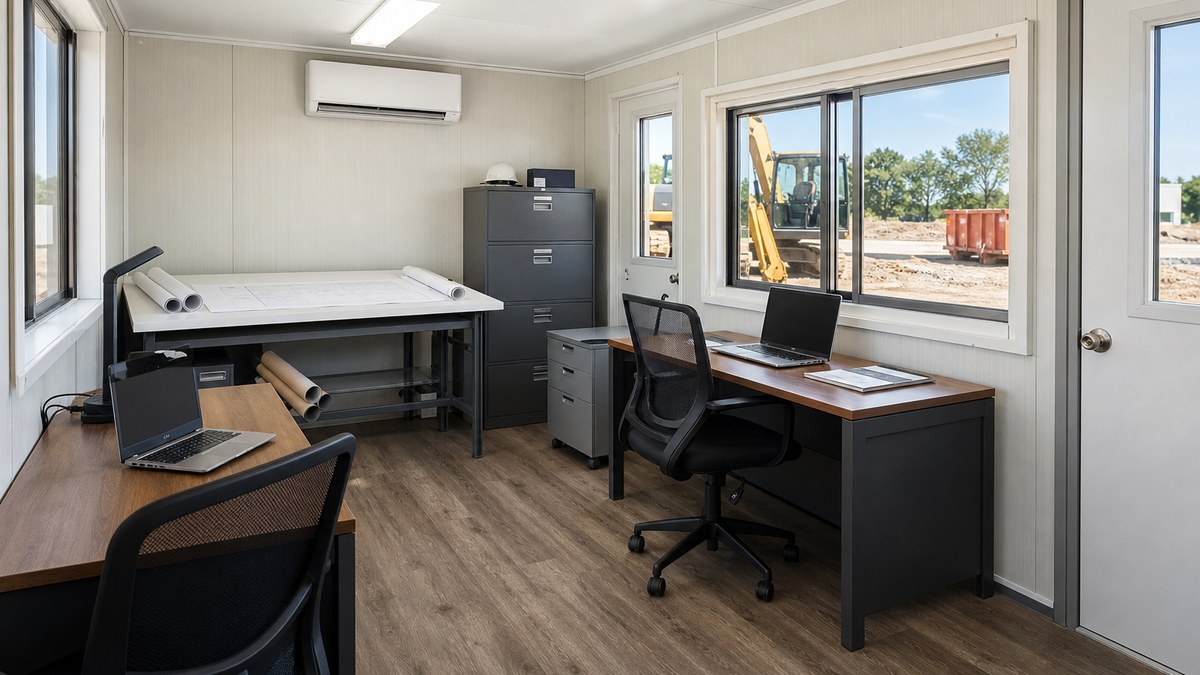
Container offices: what to know
Shipping-container offices are popular for yards, ports, remote sites and pop-up uses because they're tough, secure and easy to move. They also have a few specific issues:
- Code review. The 2021 International Building Code added Section 3115 for intermodal shipping containers repurposed as buildings or parts of buildings. Local agencies such as Alaska's Matanuska-Susitna Borough require construction documents and a structural analysis under IBC Section 3115.8.4 for containers used this way.
- Data plates. STRUCTURE magazine notes that code officials can rely on a container's CSC Safety Approval Plate to confirm it was built and inspected to ISO standards, and that a container without one can be rejected.
- Guidance. The International Code Council and the Modular Building Institute published a guideline (ICC G5) to help jurisdictions, owners and designers review containers repurposed as buildings.
- Comfort. Steel walls need insulation and a vapor strategy to avoid condensation, plus HVAC sized for the climate.
- Openings. Every door and window cut into a container changes its structure; buy from a supplier who documents the modifications.
Rules for containers used only as storage, and for temporary structures, vary by jurisdiction. Ask your building department before ordering.
Permits, codes and site work
A portable office is easy to move, but it is still a building where people work. Expect some combination of the following:
| Item | What it generally means |
|---|---|
| Zoning and temporary use | Many cities allow temporary offices during construction or for a set period; others require a temporary use permit, setbacks or screening. |
| Building permit | Often required for occupied offices. As one example, the City of Ann Arbor's temporary structures sheet, based on the Michigan Building Code, treats structures in place under 180 days as temporary and requires a permit for those over 120 square feet. |
| State approvals | Many states regulate factory-built modular buildings through a state program with a label or insignia; the Interstate Industrialized Buildings Commission lets member states share approvals. |
| Relocatable building rules | The IBC has provisions for relocatable modular buildings, which the Modular Building Institute helped write; existing relocatables that are moved or altered are pointed to the existing building code. |
| Electrical | Temporary power or a permanent service, with an electrical permit and inspection. |
| Anchoring | Blocking, leveling and tie-downs sized for local wind and soil; the supplier's setup instructions and local rules apply. |
| Accessibility | Under the 2010 ADA Standards, construction trailers directly associated with a construction project are exempt from certain accessibility requirements, but a portable office used by your business, employees or the public generally needs an accessible entrance, which usually means a ramp no steeper than 1:12. |
| Job-site rules | On construction sites, OSHA 29 CFR 1926.51 sets toilet and drinking water requirements, and 1926.150 sets fire extinguisher placement. |
Site preparation checklist
- Access. A clear route for the truck, plus room for a forklift or crane if needed. Check gates, overhead wires, turns and soft ground.
- A level, drained pad. Compacted gravel or paving, sloped so water drains away from the building.
- Power. Temporary pole or permanent service sized for HVAC, lights, computers and any equipment.
- Water and sewer if the office has a restroom, or a plan for portable toilets and drinking water.
- Data. Cellular, fixed wireless or a wired line for internet and phones.
- Parking and walkways to the entrance, plus the accessible route where required.
- Security. Lighting, locks, window bars or shutters, alarms and cameras for unattended sites.
Rent, lease or buy a portable office?
| Option | Usually fits | What to compare |
|---|---|---|
| Rent | Short projects, seasonal or event use, uncertain timelines | Monthly rate plus delivery, setup, steps, ramp, return, damage waiver and minimum term |
| Lease or lease-to-own | Multi-year use, customized offices | Term, holdover rates, maintenance, insurance, purchase option and end-of-term charges |
| Buy new | Long-term or repeated use across your own sites | Installed cost, warranty, options, resale and relocation cost |
| Buy used | Budget-driven buyers who can inspect carefully | Condition, roof and floor, HVAC age, labels and data plates, transport and refurbishment |
Many buyers searching "portable office buildings for sale near me" end up comparing a purchase with a long rental. Our rent, lease or buy guide walks through that decision, the modular building leasing guide explains lease clauses, the temporary buildings for rent guide covers short-term options, and the modular buildings for sale guide includes a used-building inspection checklist.
What drives the cost of a portable office building
We don't publish prices, because portable office quotes depend on the unit, the term and your site. The factors that move quotes most:
- Type and size. A booth or container office, a single-wide trailer and a multi-section modular office are very different buildings.
- New, used or rental fleet. Condition, age and availability in your region.
- Term. Rentals often price short terms differently from long ones; check minimums.
- Interior layout. Private offices, restroom, break area, plan tables and storage.
- HVAC and insulation. Sized for your climate, especially for container offices.
- Delivery. Distance, oversize permits, escorts and the equipment needed to set the unit.
- Setup. Blocking, leveling, tie-downs, skirting, steps and ramps.
- Utilities. Power service, water, sewer or holding tanks, and data.
- Site work. Pad, grading, drainage, paving and walkways.
- Permits and approvals. Zoning, building, electrical and any state or container review.
- Security and options. Shutters, alarms, furniture packages, signage brackets and awnings.
- Return or removal. Disconnecting, loading and hauling away at the end of the term.
For larger offices, our modular office building cost guide goes deeper into what drives price.
Why factory-built offices are faster
Portable and modular offices are built while the site is being prepared, which is where most of the time savings come from. A widely cited McKinsey analysis found modular construction can speed up projects by 20% to 50% and, in some cases, cut costs by up to 20%. A National Institute of Building Sciences summary of a U.S. Department of Energy-funded field study reported modular projects about 30% faster and about 5% lower in cost, with 40% to 60% of the work done off site. The Modular Building Institute's 2023 annual report put office and administrative buildings at 19.1% of 2022 permanent modular production. Small portable offices that come from existing rental fleets can be faster still, but results vary by project, availability and permitting.
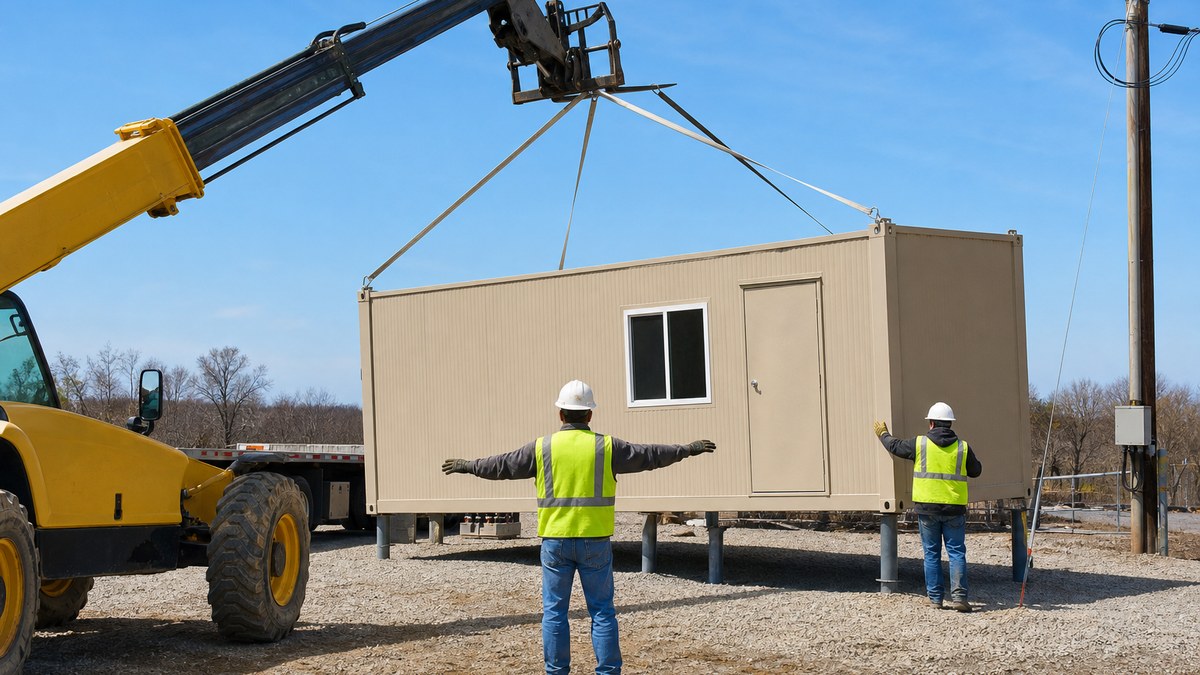
How to get a portable office delivered, step by step
- Define the need. Headcount, rooms, restroom or not, how long, and your target date.
- Check zoning and permits. Ask the city or county what applies to a temporary or portable office on your parcel.
- Choose the type. Booth, container office, trailer or modular office, based on size, term and site.
- Choose rent, lease or buy. This sets which suppliers and units are available.
- Get itemized quotes. Unit, delivery, setup, steps and ramp, utilities, options and removal listed separately.
- Prepare the site. Pad, access, power and any water, sewer and data.
- Deliver and set. The unit is placed, leveled, blocked and anchored.
- Connect and inspect. Utilities connected, steps and ramp installed, inspections passed.
- Move in, and plan the exit. Note the return notice period and what condition the building must be in.
Four portable office scenarios
1. A general contractor opens a new job
The superintendent and two project engineers need an office for an 18-month project. The contractor rents a single-wide mobile office with a private office and plan table, adds a second unit for the owner's rep when the team grows, and uses portable toilets that meet OSHA job-site counts.
2. A distribution yard needs a gate office
Drivers check in at the yard gate. The operator buys a small insulated container-style office set on piers by forklift, with a sliding window, HVAC, data and power, and anchoring for local wind.
3. A school district needs swing space
While the front office is remodeled, a district leases a relocatable modular office with a reception counter, offices, a meeting room and an ADA ramp. See our modular school buildings guide for classroom space.
4. A company opens a temporary branch
A services company tests a new market with a two-section portable office on a leased lot, with a lease-to-own option in case the branch becomes permanent.
Portable office buildings near you
We provide portable office buildings nationwide through our network of manufacturers, dealers and installers, including markets where buyers often search for portable offices, such as Minneapolis, Charlotte, Denver, Chicago, Kansas City, Atlanta, Detroit, Austin, Cleveland, Orlando, Philadelphia, Tulsa, New Orleans and Long Beach. Climate changes what a portable office needs: snow loads and freeze protection in Minneapolis, Denver and Chicago, high-wind anchoring along the Gulf and Atlantic coasts, and larger cooling systems in Texas and Florida. Find your city on the locations page.
Checklist: before you order a portable office
- How many people will use it, and for how long?
- Do you need a restroom, or will people use portable toilets or a nearby building?
- Which type fits: booth, container office, trailer or modular office?
- What are the exterior dimensions and usable interior square footage?
- Can a truck and forklift or crane reach the spot you've chosen?
- Is the pad level, compacted and drained?
- Where will power, data and any water and sewer come from?
- Which permits apply, and who pulls them?
- Does the office need an accessible entrance and ramp?
- What anchoring does your wind zone require?
- For rentals: minimum term, holdover rate, damage waiver and return conditions?
- Have you compared total cost, not just the monthly rate or purchase price?
Frequently asked questions
What is a portable office building?
A portable office building is a factory-built office delivered to a site whole or in a few sections, set on blocking or a simple foundation, connected to utilities and used right away, then moved again later. The term covers mobile office trailers, container offices, skid-mounted offices, prefab booths and relocatable modular offices.
What is the difference between a portable office and a mobile office trailer?
A mobile office trailer is one kind of portable office: an office built on a steel chassis with axles that is towed to the site. Portable office is a broader term that also includes container offices, skid-mounted offices, booths and relocatable modular buildings that are set by forklift or crane.
What sizes do portable offices come in?
Sizes range from one-room booths and container offices to single-wide trailers, double-wides and multi-section modular offices. Standard shipping containers are 8 feet wide and nominally 20 or 40 feet long. Trailers commonly run about 20 to 60 feet long, and modular sections are often 12 to about 14 feet wide. Exact sizes vary by supplier.
How many people fit in a portable office?
As a planning range, a small container office or booth suits 1 to 2 people, a single-wide trailer 3 to 6, a large single-wide or double-wide about 6 to 15, and multi-section modular offices 15 or more. Code occupant loads, exits and restrooms are calculated separately by your design professional or supplier.
Do I need a permit for a portable office building?
Often yes. Many cities require zoning approval or a temporary use permit, a building permit for occupied offices and an electrical permit for power. Rules depend on size, how long the office stays and how it is used, so check with your city or county building department before delivery.
Can I use a shipping container as an office?
Yes, but it may need code review. The 2021 International Building Code includes Section 3115 for shipping containers repurposed as buildings, and many jurisdictions require construction documents and a structural analysis. Container offices also need insulation, condensation control and HVAC sized for your climate.
Is it better to rent or buy a portable office?
Renting usually fits short or uncertain needs because delivery, setup and removal are bundled and you return the unit when done. Buying often makes sense for long-term or repeated use across your own sites. Compare total cost over the full term, including delivery, setup, steps, ramps and return or relocation.
Do portable offices need to be ADA accessible?
Generally yes if employees or the public use the office. The 2010 ADA Standards exempt construction trailers directly associated with a construction project from certain requirements, but other portable offices usually need an accessible entrance, which typically means a ramp no steeper than 1:12.
Can a portable office have a restroom?
Yes. Many trailers and modular offices can include a restroom if the site has water and sewer or a holding tank. Smaller container offices and booths usually don't, so plan for portable toilets or access to a nearby building, and follow OSHA rules on construction sites.
How do I get a quote for a portable office building?
Share your site address, headcount, how long you need the office, whether you need a restroom, whether you want to rent, lease or buy, and your target date. We return options from our nationwide network of manufacturers, dealers and installers. Call (702) 738-2218 or request a free quote online.
Need a portable office?
Tell us your headcount, site and dates. Free, no-obligation options to rent, lease or buy.
Related
Sources
- Modular Building Institute, Relocatable buildings.
- Triumph Modular, Differences between mobile offices and modular buildings.
- 360connect, Modular Buildings: A Buyer's Guide (module widths and lengths).
- Ship A Car, Inc., How to Ship a Mobile Office or Modular Building (legal width and oversize permits).
- Matanuska-Susitna Borough, Intermodal shipping containers (2021 IBC Section 3115).
- STRUCTURE magazine, Safe building with shipping containers.
- Modular Building Institute, MBI and ICC guideline for shipping containers repurposed as buildings.
- Data Driven AEC, How to calculate occupant load (IBC Table 1004.5).
- City of Ann Arbor, temporary structures information sheet (Michigan Building Code §3103).
- Interstate Industrialized Buildings Commission, FAQ.
- Modular Building Institute, MBI on IBC relocatable buildings provisions, and 2023 Permanent Modular Construction annual report.
- U.S. Access Board, 2010 ADA Standards for Accessible Design (§203.2, §405).
- OSHA, 29 CFR 1926.51 (sanitation) and 1926.150 (fire protection).
- McKinsey & Company, Modular construction: From projects to products (2019).
- National Institute of Building Sciences, 2024 summary of a U.S. Department of Energy-funded field study on modular construction.
This guide is general information, not legal or code advice. Permits, temporary-use rules, container review, accessibility and anchoring requirements vary by state and city; confirm requirements with your supplier, design professional and local building department.